GitTree vs Fork
A free alternative to the Fork Git client, Linux included
GitTree is a free desktop Git client for macOS, Windows and Linux, and a practical alternative to the Fork Git client. If you like Fork’s fast, visual way of working but need the same client on Ubuntu or Debian, would rather not buy a licence after the evaluation, or want undo, a built-in terminal and pull request review inside the app, GitTree covers that. Below is an honest, sourced comparison with Fork, including the places where Fork is still the better pick.
Free for macOS, Windows and Linux. Sign in with a free GitTree account; no licence key, no credit card. Uses your installed Git 2.39 or newer.
Last checked against Fork’s official pages:
The short answer
- Linux
- GitTree ships a .deb and an AppImage; Fork has no Linux version
- Price today
- GitTree is $0 today; Fork is $59.99 per user after a free evaluation (as of October 2026)
- Safety net
- GitTree has toolbar undo and a docked terminal; Fork relies on the reflog and an external terminal
- Getting started
- Fork bundles Git and activates with a licence key, no account; GitTree uses your Git 2.39+ and a free account
Why developers look for a Fork alternative
Fork is a fast, mature Git client for Macs and Windows PCs, with no Linux version, built by a two-person team since 2016 and updated about once a month. These are the reasons people most often give for trying something else.
There is no Linux version
A Linux build, requested in 2017, is the most-reacted issue on Fork’s public tracker. In 2017 its developer said it would not happen in the visible future, and in 2019 that it should not be expected until a mature UI toolkit exists on Linux. The only workaround people discuss is running the Windows app under Wine, which is unofficial.
A licence to buy after the evaluation
Fork can be downloaded and evaluated for free, but its licence asks you to buy a key for long-term use: $59.99 per user, one-time, as of October 2026. Fork’s official pages do not say how long the evaluation lasts.
No undo button
Fork restores lost commits through its reflog view, but its feature list and release notes show no general undo for Git operations. The Windows request to undo a discard has been open since 2020.
Shortcuts that cannot be rebound
The request to customise Fork’s keyboard shortcuts has been open on its tracker since 2017, so you work with the default key bindings.
Pull requests finish in the browser
Fork creates pull requests and, on Windows, lists pull requests and issues. Reviewing, commenting, merging and following CI checks are not described in its official material, so that work happens on the hosting site.
Two different apps
Fork for Mac and Fork for Windows are separate native apps with their own version numbers, and there is none for Linux. Features can land on one first: GPG signing is listed only for Mac, and Codex and Cursor support appear only in the Mac release notes.
Why developers choose GitTree
GitTree keeps the fast, keyboard-friendly way of working that Fork users like, and adds the tools they most often ask for.
The same app on every desktop
One GitTree, with the same version and features on macOS, Windows and Linux, so a mixed team learns one tool. Linux gets a .deb package and a portable AppImage.
Undo for the risky operations
Undo and redo from the toolbar for a commit or amend, checkout, reset, rebase, discard, branch or tag deletion and more. Every destructive step is snapshotted first, and a reflog view restores lost commits.
Pull requests without leaving the app
List, create, review, comment on and merge pull requests, see and re-run CI checks, and follow a dashboard across repositories: GitHub and Bitbucket, with newer support for GitLab and Azure DevOps.
A terminal and shortcuts your way
A built-in terminal docked under the graph runs your own shell, the command palette (Ctrl/⌘+Shift+P) reaches about 300 commands, and every shortcut can be rebound, with a cheat sheet.
Signing and tidy commits everywhere
Sign commits with GPG, SSH or X.509 on every platform, and get a Conventional Commits check, a summary length check, commit templates and co-authors.
Private by design, AI only when you ask
No telemetry, analytics or crash upload, and tokens stay in your system keychain. Optional AI drafts of commit messages and pull request descriptions run through your own Claude Code, Codex or Antigravity CLI, only when you click Generate.
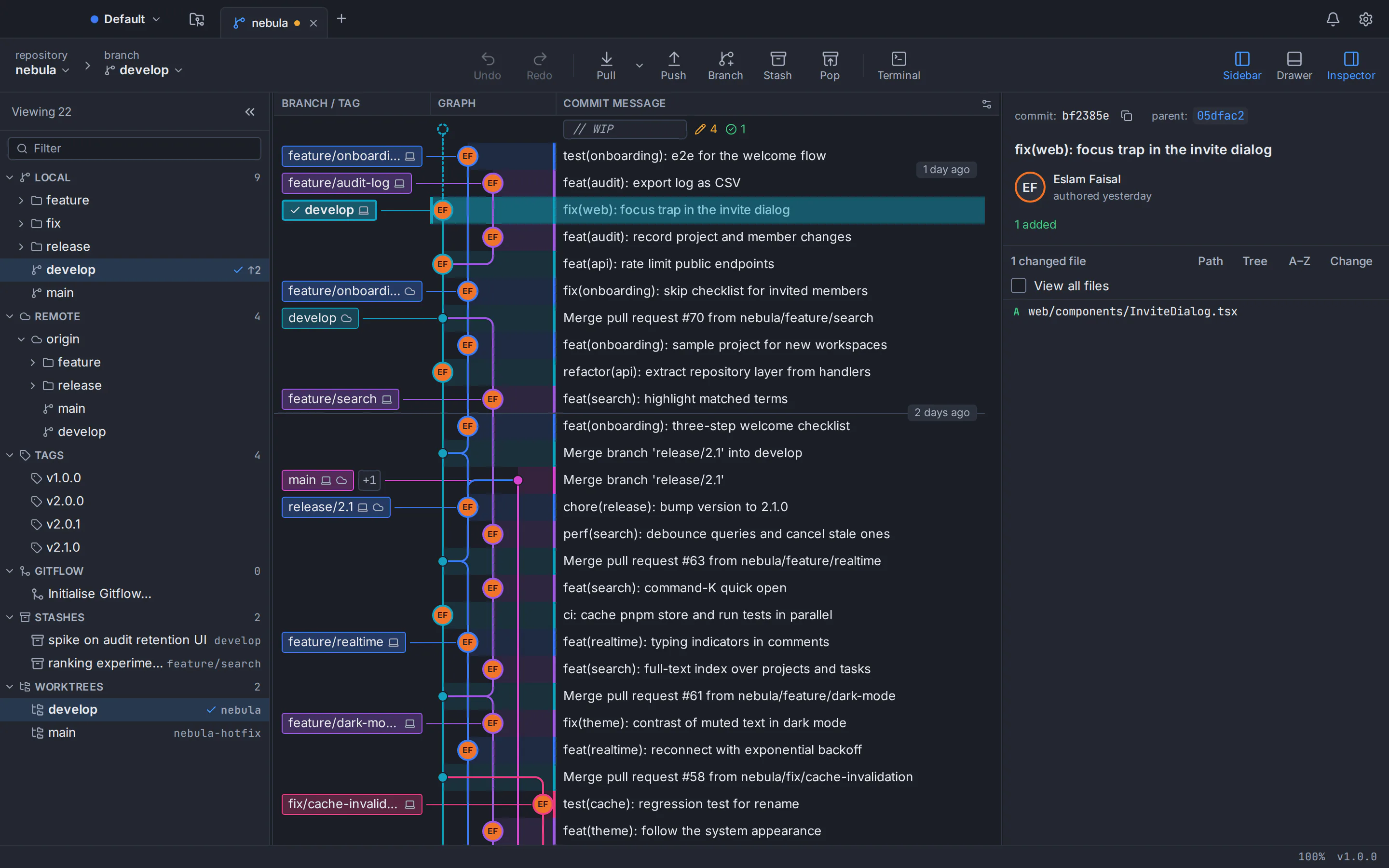
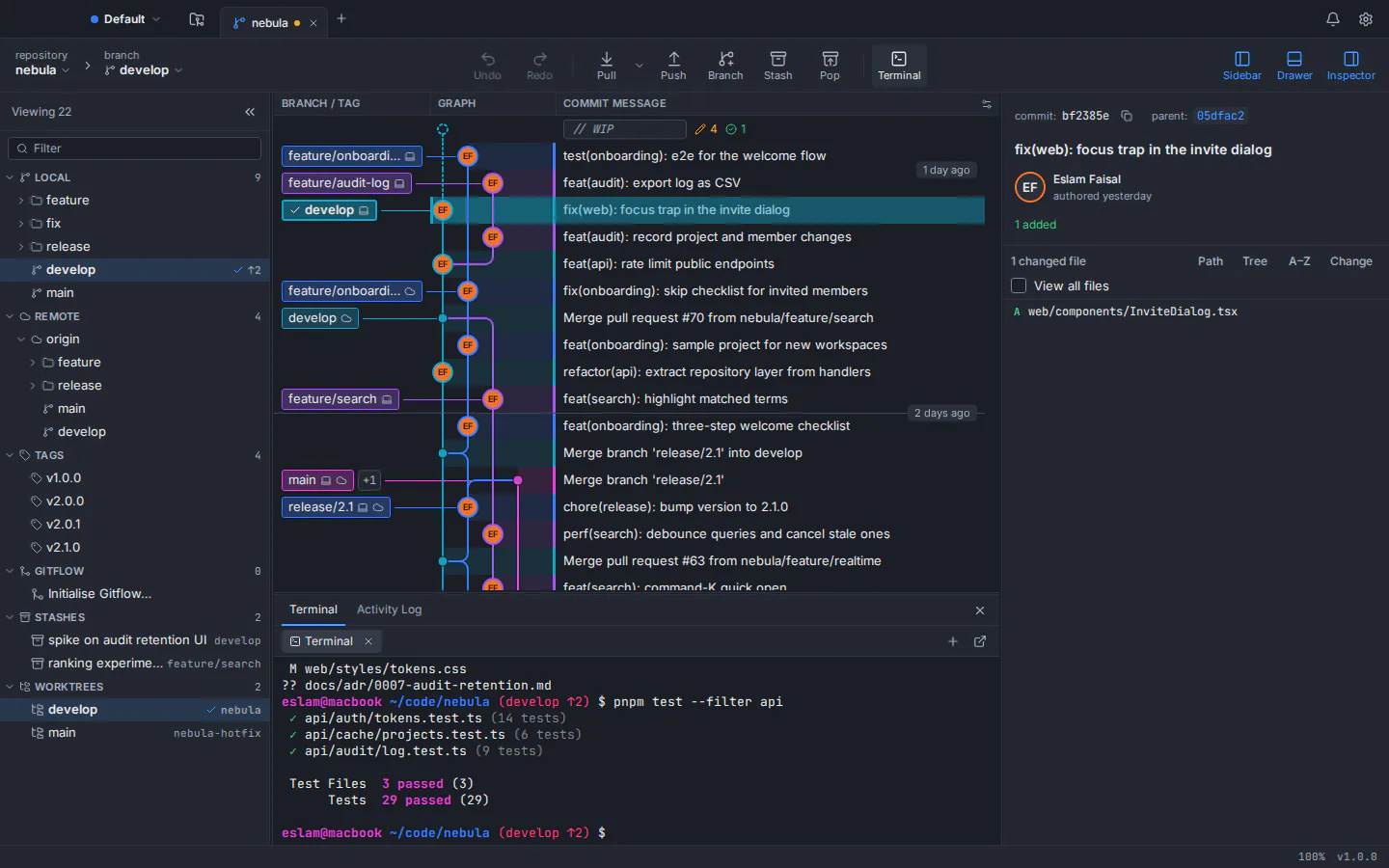
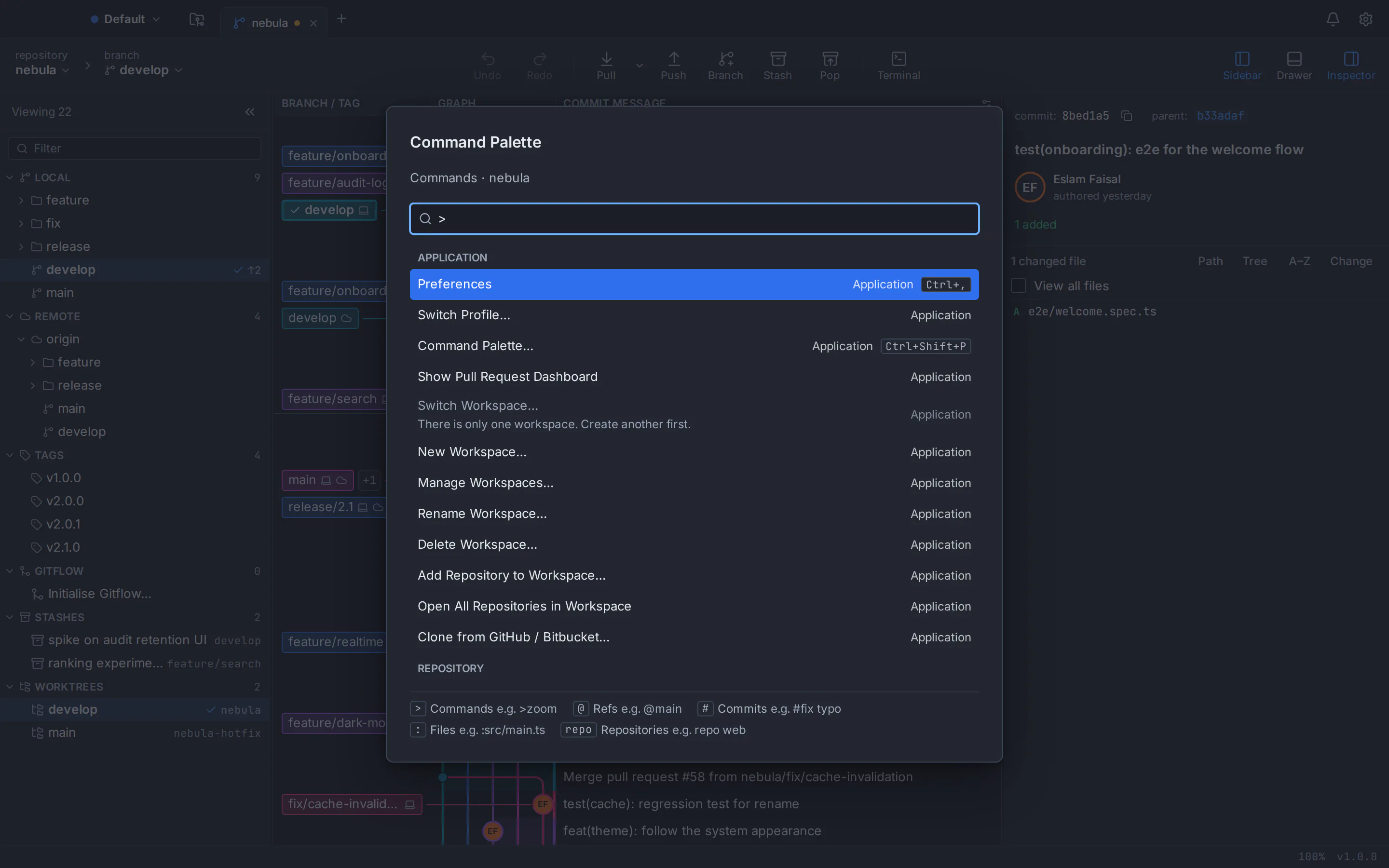
GitTree vs Fork: feature comparison
Both are fast, visual desktop Git clients with a commit graph, line staging, interactive rebase and a conflict resolver. They differ most in platforms, price model, undo and pull request work, while Fork is ahead on maturity, bundled Git, working with no account, AI code review and image handling. The official sources are linked at the bottom of the page.
- Included
- Partly, or with limits
- Needs a paid licence
- Not available
| Topic | GitTree | Fork |
|---|---|---|
| Price, licence and account | ||
| Price | GitTreeIncluded: Free today, for individuals and organizations, commercial use and private repositories included | ForkNeeds a paid licence: $59.99 per user, one-time, after a free evaluation of unstated length (as of October 2026) |
| Long-term cost | GitTreePartly, or with limits: Nothing to buy today, but no written promise about future pricing | ForkIncluded: A perpetual licence: one purchase covers personal and commercial use, no subscription |
| Source code | GitTreeNot available: Closed source; the public repository hosts releases only | ForkNot available: Closed source, under a proprietary licence |
| Account to start | GitTreePartly, or with limits: A free GitTree account, created with GitHub, GitLab, Bitbucket or Azure DevOps; online at first launch and at least every 7 days | ForkIncluded: No Fork account mentioned on its site; a licence key activates it |
| Track record | GitTreePartly, or with limits: New: version 1.2.9 in October 2026, in active development | ForkIncluded: Developed since 2016, with about one feature release a month on each system |
| Desktop systems and installers | ||
| macOS | GitTreeIncluded: One universal app for Apple silicon and Intel, macOS 13 Ventura or later, notarized by Apple | ForkIncluded: Native app with Apple silicon support; Fork’s site says OS X 10.11 or later |
| Windows | GitTreePartly, or with limits: 64-bit Windows 10 (22H2) and Windows 11; installer not code-signed yet, so SmartScreen may warn | ForkIncluded: Native app; Fork’s site says Windows 7 or later |
| Linux | GitTreeIncluded: .deb and AppImage for Ubuntu 22.04+ and Debian 12+ (x86_64) | ForkNot available: No Linux version; requested since 2017 |
| Same app on every system | GitTreeIncluded: One version with the same features everywhere | ForkPartly, or with limits: Two separate native apps, Mac 2.70 and Windows 2.23, with different feature timing; none for Linux |
| Git included | GitTreePartly, or with limits: Uses your installed Git 2.39 or newer; on Windows that means Git for Windows | ForkIncluded: Bundles Git and Git LFS, with an option to use another Git |
| Download size | GitTreeIncluded: About 20.7 MB on Mac, 7.5 MB on Windows and 11.3 MB for the Linux .deb, partly because Git is not bundled | ForkIncluded: About 32.5 MB on Mac and 76 MB on Windows, Git included; no Linux download |
| History, staging and commits | ||
| Visual commit graph | GitTreeIncluded: Colour-coded lanes, labels and avatars; search by message, author, hash, file or change; smooth past 100,000 commits | ForkIncluded: Commit list with a graph, collapsible merges, stashes in the list and search by message, diff or path |
| Hunk and line staging | GitTreeIncluded: Files, hunks or single lines, plus partial stash | ForkIncluded: Line-by-line and chunk staging, plus partial stash |
| Interactive rebase | GitTreeIncluded: Pick, reword, edit, squash, fixup and drop; reorder by drag or keyboard; autosquash and update-refs | ForkIncluded: Visual dialog with pick, reword, squash, fixup and drop, drag-and-drop squash and update-refs |
| Undo and redo | GitTreeIncluded: Toolbar undo and redo for commits, checkouts, resets, rebases, discards and deletions, plus a reflog view | ForkPartly, or with limits: No general undo listed; lost commits are restored from the reflog |
| Merge conflicts | GitTreeIncluded: Full-window three-way editor with per-hunk and per-line choices, rerere and conflict prediction before a merge | ForkIncluded: Built-in resolver with an optional three-column layout; shows whether a cherry-pick or revert applies cleanly |
| Signed commits | GitTreeIncluded: GPG, SSH or X.509 on every platform, with signature badges in the graph | ForkPartly, or with limits: GPG on Mac; not listed for Windows (request open), and no Linux app |
| Commit message checks | GitTreeIncluded: Conventional Commits lint, summary length check, templates and co-authors | ForkPartly, or with limits: Access to recent commit messages; Conventional Commits support is an open request |
| Repository workflow | ||
| Worktrees, submodules and Git LFS | GitTreeIncluded: All three: add, move, lock and prune worktrees; LFS track, pull, prune and locks | ForkIncluded: All three, including LFS locks and checking out a remote branch as a worktree |
| Stash, blame and file history | GitTreeIncluded: Partial stash, rename and branch from a stash; blame that follows renames; file history | ForkIncluded: Partial stash, rename and save as patch; blame timeline; history of a selected hunk |
| Image diffs and previews | GitTreeIncluded: Image diff side by side, with swipe and onion skin; Markdown preview | ForkIncluded: Swipe, onion skin and pixel-exact highlighting; SVG, HEIC, TGA and WebP previews, plus PDF on Mac; merges images and LFS files |
| Built-in terminal | GitTreeIncluded: Docked under the graph, running your own shell | ForkNot available: None in its feature list or release notes; it opens your external terminal app instead |
| Command palette and shortcuts | GitTreeIncluded: About 300 commands (Ctrl/⌘+Shift+P); every shortcut can be rebound | ForkPartly, or with limits: Quick Launch palette (Ctrl/⌘+P); shortcuts cannot be rebound |
| Repository statistics, notifications and CLI tool | GitTreeNot available: Not offered | ForkIncluded: Repository statistics and treemap, GitHub notifications, vertical tabs and a fork command-line tool |
| Hosting, pull requests and AI | ||
| GitHub and Bitbucket | GitTreeIncluded: Accounts for GitHub and Bitbucket Cloud: browse, clone, publish and work with pull requests | ForkIncluded: GitHub and Bitbucket integrations, with sign-in for both |
| GitLab, Azure DevOps and self-hosted servers | GitTreePartly, or with limits: Early support for GitLab, Azure DevOps, GitHub Enterprise Server and Bitbucket Data Center | ForkIncluded: GitLab (cloud and self-hosted), Azure DevOps pull requests, GitHub Enterprise and Bitbucket Server |
| Gitea and issue-tracker links | GitTreeNot available: Gitea works as a plain remote; no Jira link highlighting | ForkIncluded: Gitea integration; Jira and Redmine links highlighted in commit messages |
| Pull requests and CI checks | GitTreeIncluded: List, create, review, comment and merge; labels, assignees, CI checks with re-run and a dashboard across repositories | ForkPartly, or with limits: Creates pull requests and lists pull requests and issues on Windows; review, merge and CI checks are not described |
| AI commit messages | GitTreeIncluded: Drafts through your own Claude Code, Codex or Antigravity CLI, also for pull request titles and descriptions | ForkIncluded: Through your own Claude Code on both systems, plus Codex and Cursor on Mac |
| AI code review | GitTreeNot available: Not offered | ForkIncluded: Branch review with your own Claude Code; commit ranges and Codex on Mac |
| Privacy, language and accessibility | ||
| Published privacy statement | GitTreeIncluded: No telemetry, analytics or crash upload; tokens in the system keychain | ForkNot available: No privacy page found on Fork’s site; this is not a claim about what the app collects |
| Interface languages | GitTreeIncluded: English and Arabic, with a full right-to-left layout | ForkPartly, or with limits: English; no other interface language appears on its site |
| Accessibility | GitTreeIncluded: Two high-contrast themes, 50–300% zoom and reduce motion; designed for keyboard and screen-reader use | ForkPartly, or with limits: Requests for interface zoom and font size are open on its trackers |
| Work and personal identities | GitTreeIncluded: Profiles keep them apart without editing ~/.gitconfig | ForkPartly, or with limits: A separate identity per workspace is an open request on Windows |
This table compares the current public products, not every setting. Fork’s Mac app and its Windows app differ, there is no Linux app, and the rows say where. GitTree is in active development; check its features page and release notes before moving a critical workflow.
Fork price vs GitTree
Fork is a one-time purchase after a free evaluation. GitTree costs nothing today, for individuals and companies alike.
GitTree
$0everything the app does today
- Private, public and local repositories
- Commercial use and organizations included
- Undo, the conflict editor, pull requests and every other feature
- Builds for macOS, Windows and Linux
Fork
$59.99one-time, per user, after a free evaluation
- Personal and commercial use
- 1 user on up to 3 machines at a time
- One key covers its macOS app and its Windows app; no Linux version
- No subscription; no student, team or volume price listed
Fork’s price was checked on its official buy and licence pages in October 2026; they do not say how long the evaluation lasts. Prices change, so see Fork’s buy page for the current figure. If GitTree adds paid team plans, they will be announced in your account before anything changes.
A Fork alternative for Mac, Windows and Linux
The same GitTree on macOS, Windows and Linux, running the Git 2.39 or newer that you already have installed.
Fork alternative for Mac
One universal app that runs natively on Apple silicon and Intel Macs with macOS 13 Ventura or later, signed with an Apple Developer ID and notarized by Apple.
Fork alternative for Windows
An installer of about 7.5 MB for 64-bit Windows 10 (22H2) and Windows 11 that uses your Git for Windows. It is not code-signed yet, so SmartScreen may ask you to confirm.
Fork alternative for Linux
Fork has no Linux version. GitTree offers a .deb package or a portable AppImage for 64-bit Ubuntu 22.04+ and Debian 12+; on Ubuntu 22.04 and Linux Mint 21, add ppa:git-core/ppa for a newer Git first.
Read the Linux install guide
Which one should you choose?
Both are good Git clients. Pick the one that matches how you work today, then try it on a noncritical repository before you move daily work.
Choose GitTree if…
- You need one Git client across a mixed macOS, Windows and Linux team, or on Linux alone
- You want a free client for commercial work, with no licence to buy
- You want undo, a built-in terminal and shortcuts you can rebind
- You review and merge pull requests and follow CI checks without leaving the app
- You want GPG, SSH or X.509 signing on every platform, or an Arabic interface
Consider Fork if…
- You only use Macs and Windows PCs (Fork has no Linux version) and want a fully native app with about ten years of history
- You want to work with no account or online sign-in, with Git and Git LFS bundled
- You prefer a one-time licence to software that is free today with no long-term pricing promise
- You rely on AI code review with Claude Code or Codex, Gitea integration or Jira link highlighting
- You must stay on an operating system older than GitTree supports, or need richer image previews and repository statistics
How to switch from Fork to GitTree
Switching is quick. Your repositories are plain Git, so Fork and GitTree can open the same folders side by side while you decide.
Install Git 2.39 or newer
Fork bundles its own Git, while GitTree uses yours. Check with git --version; on Windows install Git for Windows, and on Ubuntu 22.04 or Linux Mint 21 add ppa:git-core/ppa first.
Download GitTree
Get the free installer for macOS, Windows or Linux from the download page and install it.
Sign in with a free account
Create a free GitTree account on this website with GitHub, GitLab, Bitbucket or Azure DevOps, then sign in from the app. There is no licence key to enter.
Open the repositories you already have
Choose Open, or scan a folder for repositories. History, branches, remotes, stashes and worktrees live in the repositories themselves, so there is nothing to import from Fork.
Connect your accounts and tools
Optionally connect GitHub, GitLab, Bitbucket or Azure DevOps in Preferences for pull requests and CI checks, then set your external diff and merge tools, signing key, theme and shortcuts.
Try it on a test branch
Create a branch, stage a few lines, commit and push, then try an interactive rebase and an undo before you move daily work.
Fork alternative: frequently asked questions
What is the best free alternative to the Fork Git client?
If you want a fast, visual Git client with no licence to buy, GitTree is built for that: a free desktop app for macOS, Windows and Linux with a commit graph, line staging, interactive rebase, a three-way conflict editor, undo and pull requests in the app. Try it on one repository next to Fork and compare.
Is Fork free?
Not for long-term use. Fork can be downloaded and evaluated for free, but its licence asks you to buy a key for continued use: $59.99 per user, one-time, covering personal and commercial use on up to 3 machines (as of October 2026). Its official pages do not state how long the evaluation lasts.
How much does Fork cost?
As of October 2026, Fork costs $59.99 as a one-time purchase for one user on up to 3 machines at a time, and the same key works for its Mac app and its Windows app (there is no Linux version). There is no subscription, and no student, team or volume price is listed. GitTree is free today.
Does Fork run on Linux?
No. Fork is made only for Macs and Windows PCs, with no Linux version. A Linux build has been requested on Fork’s issue tracker since 2017, and in 2019 its developer said not to expect one until a mature UI toolkit exists on Linux. Some people run the Windows app under Wine, which is unofficial. GitTree offers a .deb package and an AppImage for Ubuntu and Debian.
What is the best Fork alternative for Linux and Ubuntu?
GitTree brings a visual Git workflow like the one Fork users know to Linux: a .deb package and a portable AppImage for 64-bit Ubuntu 22.04 or later and Debian 12 or later. Derivatives with WebKitGTK 4.1, such as Linux Mint 21+ and Pop!_OS 22.04+, can run it too, though they are untested. It needs Git 2.39 or newer; on Ubuntu 22.04 and Linux Mint 21, add ppa:git-core/ppa first.
Can I use GitTree for commercial work?
Yes. GitTree is free today for individuals and organizations, commercial use and private repositories included. Fork’s licence also covers commercial use, once you buy a key for long-term use.
Can I open my Fork repositories in GitTree?
Yes. Both apps work on ordinary Git repositories, so there is nothing to export or import. Open the same folder in GitTree and its branches, remotes, stashes, worktrees and history are already there. Fork’s own settings, such as its workspaces and custom commands, do not carry over.
Does GitTree bundle Git like Fork does?
No. Fork ships its own Git and Git LFS; GitTree runs the Git already on your computer, version 2.39 or newer, so every action matches the command line. On Windows, install Git for Windows first. If Git is missing, the app explains how to install it.
Do I need an account to use GitTree?
Yes, a free GitTree account, created with GitHub, GitLab, Bitbucket or Azure DevOps. The first launch needs a network connection; after that the app keeps working without one for up to 7 days between checks. Fork uses a licence key instead of an account, which some people prefer.
Can GitTree undo a Git operation?
Yes. Undo and redo in the toolbar cover a commit or amend, checkout, reset, rebase, discard, branch or tag creation and deletion, clean and more, and every destructive step is snapshotted first. A force-push cannot be undone in place because it changed the remote, but its snapshot stays recoverable. Like Fork, GitTree also has a reflog view for lost commits.
Does GitTree have AI features like Fork?
Yes, in a similar bring-your-own-agent way. GitTree drafts commit messages and pull request titles and descriptions through your own Claude Code, Codex or Antigravity CLI, only when you click Generate, and stores no AI key. Fork also offers AI commit messages and adds AI code review of branches, which GitTree does not have.
Does GitTree have a built-in terminal and custom shortcuts?
Yes. A terminal running your own shell docks under the graph, and every keyboard shortcut can be rebound, with a cheat sheet. Fork opens an external terminal, and the request to customise its shortcuts is still open.
Can I review and merge pull requests in GitTree?
Yes. GitTree lists, creates, reviews, comments on and merges pull requests (merge, squash or rebase), sets labels and assignees and shows CI checks you can re-run, with a dashboard across repositories. GitHub and Bitbucket are the most tested; GitLab and Azure DevOps support is newer. Inline comments on the diff are not supported.
Does GitTree sign commits on Windows?
Yes. GitTree signs commits with GPG, SSH or X.509 on macOS, Windows and Linux, and shows signature badges in the graph. Fork lists GPG signing for Mac; it is not listed for Windows, where the request is still open.
Is the source code of GitTree or Fork available?
No. GitTree is free today but closed source; its public GitHub repository hosts releases only. Fork is closed source too, under a proprietary licence. If you need an open-source client, neither app fits.
Does GitTree collect usage data or upload my code?
No. GitTree has no telemetry, analytics or crash upload, and your repositories stay on your computer. It talks only to your remotes, the accounts you connect, the GitTree account service for sign-in and an update check you can switch off. An AI draft sends the staged diff to the AI CLI you chose, only when you click Generate.
Which runs on older computers, Fork or GitTree?
GitTree needs macOS 13 Ventura or later, 64-bit Windows 10 (22H2) or Windows 11, or 64-bit Ubuntu 22.04+ or Debian 12+ on Linux. Fork’s site lists older minimums, OS X 10.11 and Windows 7, which we have not tested ourselves, so on an older machine Fork may be the better fit.
How this comparison was checked
Fork’s price, licence, platforms and features were reviewed on 5 October 2026 against its official website, its release notes for each system and its public issue trackers. Prices and capabilities change; the developer’s current pages are the source of truth.
- Fork home page and feature overview
- Fork price
- Fork licence agreement
- Fork release notes for Mac
- Fork release notes for Windows
- About Fork and its developers
- Fork tracker: Linux version request
- Fork tracker: keyboard shortcut customisation request
- Fork for Windows tracker: GPG signing request
- Fork for Windows tracker: undo discard request
- GitTree features
GitTree is an independent product and is not affiliated with or endorsed by the owner of Fork. Fork is a trademark of its respective owner.
Compare Git clients
Switching from another Git client?
Honest, sourced comparisons with the Git GUIs developers use most, including what each one does better.
GitKraken alternative
Private repositories, deep undo and AI drafts with your own CLI at no cost, compared row by row with GitKraken Desktop.
Sourcetree alternative
Runs on Linux too, with a built-in conflict editor, undo and in-app pull requests, compared row by row with Sourcetree.
GitHub Desktop alternative
A commit graph, full interactive rebase and an official Linux build, compared row by row with GitHub Desktop.
Tower alternative
No subscription, a Linux build and a line-level conflict editor, compared row by row with Tower.
SmartGit alternative
Free for commercial use with no licence application, plus a docked terminal, undo and AI drafts, compared row by row with SmartGit.
Sublime Merge alternative
No licence to buy, plus pull requests, a drag-and-drop rebase plan and undo, compared row by row with Sublime Merge.
Try the free Fork alternative on your own repository
Download GitTree, open a repository you already use in Fork and compare the graph, staging, undo and pull request tools for yourself, on macOS, Windows or Linux.